
Investment Reports: Interviews
Investment Reports: Interviews
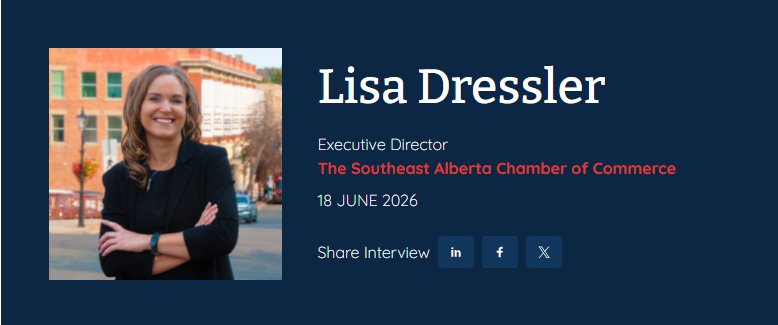
The Southeast Alberta Chamber of Commerce is a not-for-profit business organization representing companies across Medicine Hat, Brooks, and the surrounding region. Founded in 1900, the Chamber advocates on behalf of local businesses while supporting economic development, networking, and business growth across Southeast Alberta.
You've spent much of your career working at the intersection of business, government and community leadership. Where does that commitment to civic engagement originate from?
My parents were always involved in the community through organizations, initiatives and volunteer work, so I started getting involved at a very young age. I am passionate about Canada, Alberta and particularly Southeast Alberta.
I firmly believe Canada is one of the best places to do business, with tremendous untapped potential. If Canada is the best place to do business globally, and Alberta is the best place to do business in Canada, then Medicine Hat and Southeast Alberta are certainly among the best places to do business because of the opportunities we have here.
It also comes from being an agent of change and recognizing that change is part of everyday life. The better we understand our assets and opportunities, the better positioned we are to adapt, build resilience, diversify and grow.
For those unfamiliar with the Southeast Alberta Chamber of Commerce, what role does it play in supporting businesses across the region?
We focus on three core pillars: connections, support and influence.
Connections mean linking consumers to businesses, businesses to government, and businesses to one another. Support means helping businesses navigate resources, whether that's cost savings or understanding their challenges and matching them to services and supports that meet those needs. Influence means taking business concerns forward to local, provincial and federal governments and pursuing practical solutions that help businesses succeed.
Having travelled extensively across Canada, what do people most often misunderstand about Southeast Alberta?
The biggest misconception is that viable, investment-ready opportunities only exist in Canada's large metropolitan centres. Many regional and rural communities face similar assumptions around infrastructure, transportation and economic opportunity.
People often view major cities as the centres of economic activity, but a healthy economy depends on a hub-and-spoke model where all regions contribute. Southeast Alberta may be farther from major urban centres, but it has a great deal to offer.
What have been the region's enduring advantages, and how are they shaping its next chapter?
As much as things change, some things stay the same: people, place and the stories we tell. I love talking about the Medicine Hat story. Back in 1914, we were the manufacturing centre of Western Canada. During construction of the railway bridge across the river, a tent village was established, and through drilling for wáter, they discovered natural gas, leading Rudyard Kipling to famously say that Medicine Hat had "all hell for a basement." That access to low-cost energy helped establish several manufacturing industries, such as our historic clay district, where products stamped Medalta, along with clay pipes and fine china, which were used across Canada, were manufactured.
Natural gas became a major economic driver, but the region's strengths also include available land, strategic transportation corridors and a strong agricultural base. Today, those same advantages are creating opportunities in diversified energy, aerospace, defense and value-added agriculture. Our future opportunities are building directly on the assets that established the region in the first place.
What do you see as the biggest barriers standing between Southeast Alberta and its full potential?
Connectivity creates both opportunities and challenges, particularly for rural regions outside major metropolitan centres. We have strong road and rail infrastructure, but we're also a landlocked province, which makes access to markets critical. Many industries rely on both the Port of Vancouver and the Port of Montreal. When delays occur, products sit idle, businesses face additional costs, and the impacts ripple throughout the economy.
Part of the challenge is understanding the assets we have and what opportunities those assets create. Whether it's energy, power, water or infrastructure, we need clarity around what level of growth those resources can support. Ultimately, it comes down to investment readiness and awareness. Regions that understand their assets, identify opportunities and effectively reach investors are the regions that grow. The more we can streamline regulation, understand our assets and clearly communicate opportunities, the more likely we are to attract investment.
There's been renewed momentum around strengthening Canada's economy and reducing trade barriers. Is that translating into meaningful change for businesses on the ground?
It is. Reducing interprovincial trade barriers is something chambers of commerce have long advocated for. As external pressures increase costs for businesses, there is growing focus on encouraging more trade and investment within Canada. We were pleased to see that momentum build and to see the One Canada Act move forward.
That said, barriers still remain. The federal government has enabled important conversations, but provinces and territories still need to determine how changes work within their own regulatory environments. The more we can do business within our own country, the better. The next step is ensuring businesses understand what has changed and how they can take advantage of new opportunities, and continuing to work on the barriers that remain.
As Southeast Alberta continues to diversify its economy, where do you see the greatest opportunities emerging over the next decade?
My mind immediately goes to agriculture, agritech, agri-food and value-added manufacturing. Alberta produces tremendous value from its resources, but much of that value is still processed elsewhere before returning as a finished product. One of the biggest opportunities is adding more value here at home, whether through agriculture, agri-food, natural resources or minerals. Creating an environment where businesses can process, manufacture and add value domestically and still be competitive is one of the most significant opportunities I see for the future.
As populations grow, there will be increasing demand to produce more food, more efficiently, for more people. Beyond that, aviation and drone technology represent another significant opportunity. We have an aerospace hub, unique beyond-visual-line-of-sight airspace and strategic assets such as CFB Suffield, one of the largest live-fire military training areas used by NATO forces, and the largest in Canada. We're also exploring opportunities in carbon capture, utilization and storage, hydrogen and energy diversification. Tourism also remains an important part of the region's future, supported by the natural beauty of Southeast Alberta and the fact that we're the sunniest place in Canada. We need more people to see both the beauty and opportunity in Southeast Alberta.
Online link: https://www.investmentreports.co/interview/lisa-dressler-2382