
TIMES COLONIST: Trip to Medicine Hat offers pleasant surprises and precious memories
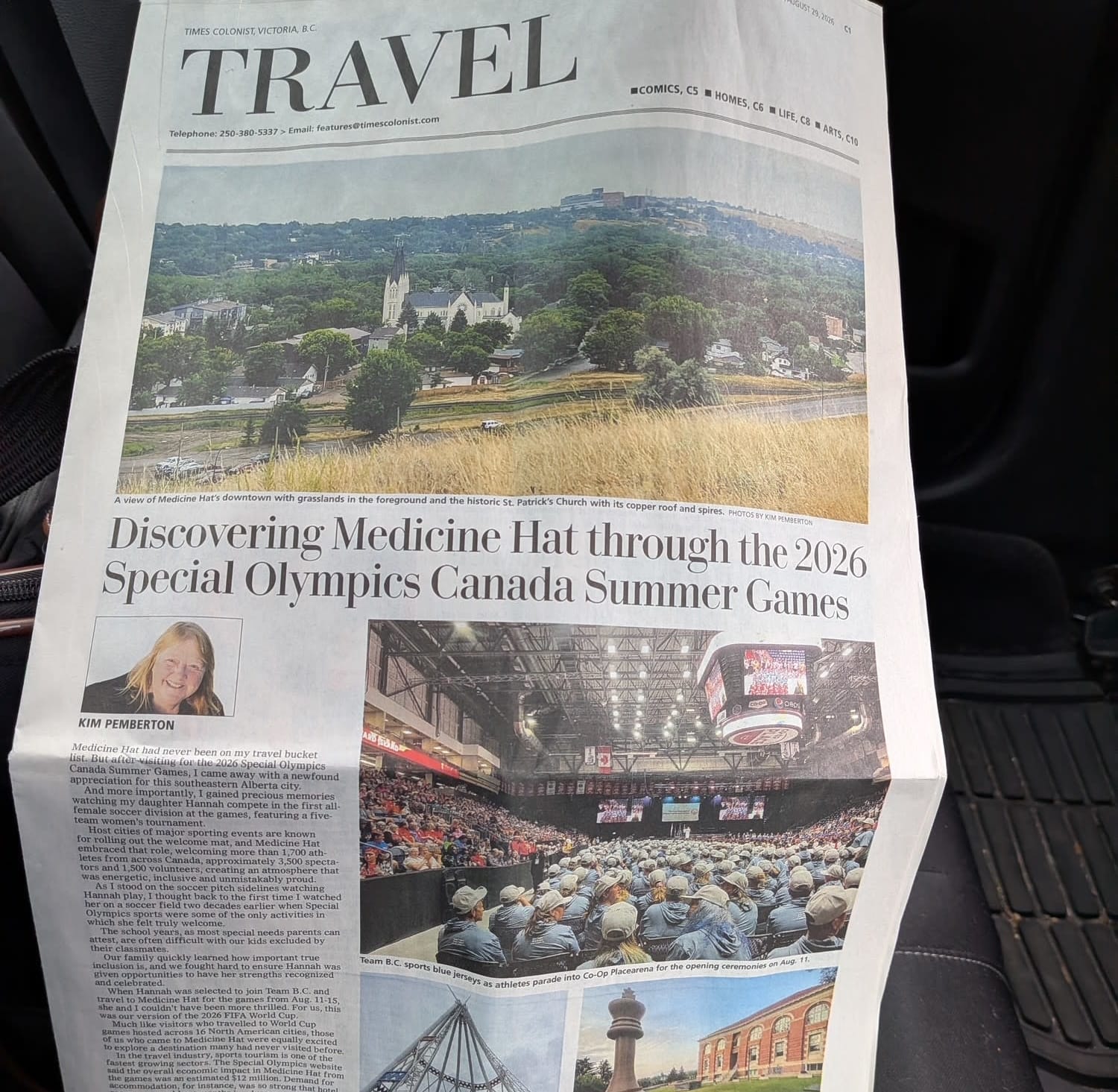
TIMES COLONIST: Trip to Medicine Hat offers pleasant surprises and precious memories
Trip to Medicine Hat offers pleasant surprises and precious memories
Host cities of major sporting events are known for rolling out the welcome mat, and Medicine Hat embraced that role for the 2026 Special Olympics Canada Summer Games.
Kim Pemberton | Aug 29, 2026 3:45 AM
Medicine Hat had never been on my travel bucket list. But after visiting for the 2026 Special Olympics Canada Summer Games, I came away with a newfound appreciation for this southeastern Alberta city.
And more importantly, I gained precious memories watching my daughter Hannah compete in the first all-female soccer division at the games, featuring a five-team women’s tournament.
Host cities of major sporting events are known for rolling out the welcome mat, and Medicine Hat embraced that role, welcoming more than 1,700 athletes from across Canada, approximately 3,500 spectators and 1,500 volunteers, creating an atmosphere that was energetic, inclusive and unmistakably proud.
As I stood on the soccer pitch sidelines watching Hannah play, I thought back to the first time I watched her on a soccer field two decades earlier when Special Olympics sports were some of the only activities in which she felt truly welcome.
The school years, as most special needs parents can attest, are often difficult with our kids excluded by their classmates.
Our family quickly learned how important true inclusion is, and we fought hard to ensure Hannah was given opportunities to have her strengths recognized and celebrated.
When Hannah was selected to join Team B.C. and travel to Medicine Hat for the games from Aug. 11-15, she and I couldn’t have been more thrilled.
For us, this was our version of the 2026 FIFA World Cup.
Much like visitors who travelled to World Cup games hosted across 16 North American cities, those of us who came to Medicine Hat were equally excited to explore a destination many had never visited before.
In the travel industry, sports tourism is one of the fastest-growing sectors. The Special Olympics website said the overall economic impact in Medicine Hat from the games was an estimated $12 million. Demand for accommodation, for instance, was so strong that hotel rooms were sold out months in advance and many families had to travel an hour outside the city to find a hotel room.
I was relieved that my friend was able to secure one of the last available rooms in Medicine Hat at a hotel in the midst of a major renovation.
But none of that mattered. This was a trip that combined watching soccer with sightseeing, discovering restaurants and experiencing some of Medicine Hat’s top attractions.
As I chatted with other parents throughout the games, one conversation kept coming up: how surprised we all were by how much Medicine Hat has to offer visitors.
Here are my top picks:
Sunshine Trolley
The Sunshine Trolley is one of the best ways to get familiar with Medicine Hat. The 90-minute-long guided city tour, starting at $25 per ticket, is aboard a bright red replica streetcar on wheels stopping at important city landmarks and viewpoints. At Jeffries Scenic View, for instance, we got off to walk out to a prominent hillside for a sweeping view of grasslands, the South Saskatchewan River, the historic downtown and the copper roof and spires of St. Patrick’s Church, a national historic site. The historic church was built in 1912 using continuous-pour concrete construction, with towers reaching 46-metres in height.
The viewpoint was named after Chris Jeffries (1894-1963), a pioneer of organized sports in Medicine Hat. The trolley also offers specialty tours, such as an art series tour, ice cream crawl and market tour, and the company offers downtown walking tours, including to bakeries, art galleries and coffee shops.
Medalta Museum
Located in Medicine Hat’s 150-acre Historic Clay District is a national historic site that tells the history of Medicine Hat’s clay and pottery industry. In the early 1900s, the clay district distributed one-third of all clay in Canada. Medalta, which operated between 1912 and 1954, was mostly known for its durable glazed stoneware crocks, butter churns, mixing bowls and jugs. The pottery was created in beehive kilns, based on a medieval design, that are still standing today.
Medalta collections manager Sarah Schatz explained Medicine Hat has over 100 years of ceramic industry history and it still produces modern ceramics and replica Medalta ware.
Asked why Medicine Hat was a pottery hub, Schatz said: “Medicine Hat was known as the gas city and industry was attracted to it because of cheap land, free natural gas and it was close to the river for water. The clay banks on our river were the best for making bricks — that’s why we have so many brick buildings standing in Medicine Hat.”
The earliest clay factory was a brick factory that opened in 1886 and closed in 2010. All of the historic downtown is made from local clay bricks.
Saamis Tepee
Saamis Tepee, located right next to the Trans-Canada highway and the local visitor information centre, is Medicine Hat’s most prominent landmark and is considered the world’s largest tepee, erected in 1991.
The main mast of the tepee is 215 feet high, or the height of a 20-storey building, and the diameter is 160 feet wide. Within the circle of the tepee are 10 illustrated storyboards explaining the influences and history of the local Indigenous people.
Below the Saamis Tepee is the Saamis Archeological Site, in the Valley of the Seven Persons Creek, which is considered one of the most important sites of the Northern Plains. It was once a buffalo camp and meat processing site, believed to have existed between 1390 and 1820 A.D. Archeologists believe there are over 83 million artifacts buried in the valley.
Food and drink
The Hat’s Olive Tap is both an olive oil and balsamic vinegar tasting room and a lunch bistro. The meals are made from scratch, using high quality oils and vinegars. We ordered the basil pesto chickpea with a side order of focaccia bread and a hand-held egg salad on focaccia bread.
D’Carlo Pasta House in downtown Medicine Hat is popular among locals who appreciate its flavourful pasta dishes at an affordable price, warm hospitality and cozy ambiance. Portions are generous and I appreciate there’s a special rate for children and seniors. I ordered a delicious pistachio pasta with shrimps as an add-on. Their caesar salads feature a homemade dressing that is so popular it has been bottled and is available for patrons to purchase.
Sabai Infusion Restaurant with authentic Thai cuisine was my favourite dining spot, in a historic brick building downtown with a view to a 100-year-old mural on another historic brick building across the street. We ordered a tofu and vegetable rice curry that was overflowing with fresh vegetables. It was so plentiful we had no room for dessert. The restaurant was a quiet oasis downtown, that the evening we visited was abuzz thanks to a rib fest happening downtown.
The four days we spent in Medicine Hat — filled with intense soccer matches, fun sightseeing adventures, and delicious culinary discoveries — ended far too quickly.
But the true highlight for our family came at the awards ceremony, when Hannah and her teammates on the B.C. Coastal Crush team proudly brought home the silver medal. In that moment, Hannah became an Olympic medallist and I couldn’t have been prouder.
Read this story online: Discovering Medicine Hat through the 2026 Special Olympics - Victoria Times Colonist